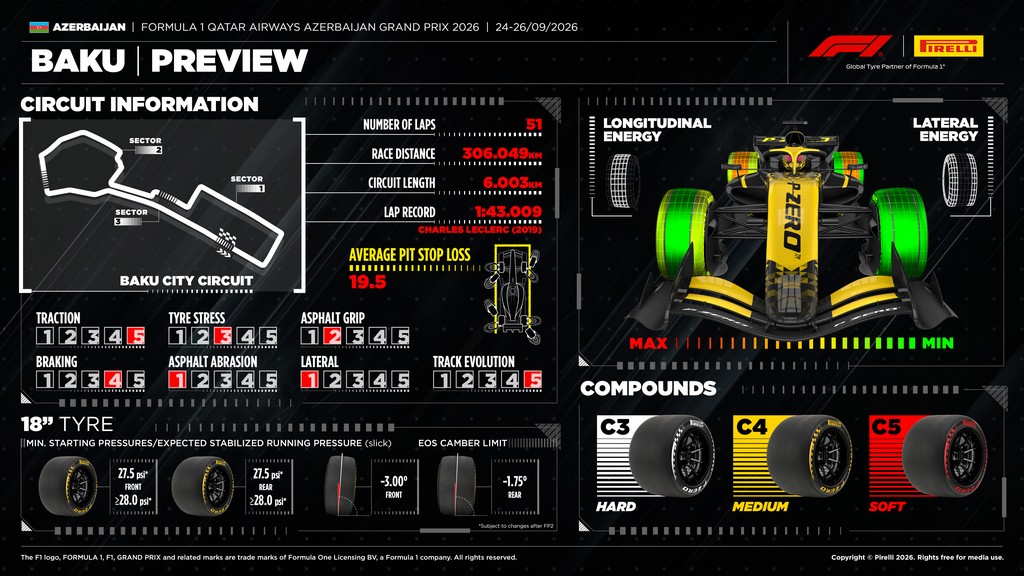
The next triple header will get underway in Baku, the capital of Azerbaijan and home to one of the fastest and most distinctive street circuits on the calendar. The track is 6.003 kilometres long and features 20 corners, some of them at right angles, with highly technical sections through the old city and long straights where the cars reach very high speeds.
Some of the city streets that make up the circuit have been resurfaced. The work has affected sections of Turns 2, 3 and 4. The new asphalt, limited to specific areas, should not influence tyre behaviour which, as is often the case on street circuits, will initially be affected by rather low grip levels. Track evolution over the course of the weekend is instead expected to be significant, thanks to the progressive build-up of rubber on the surface.
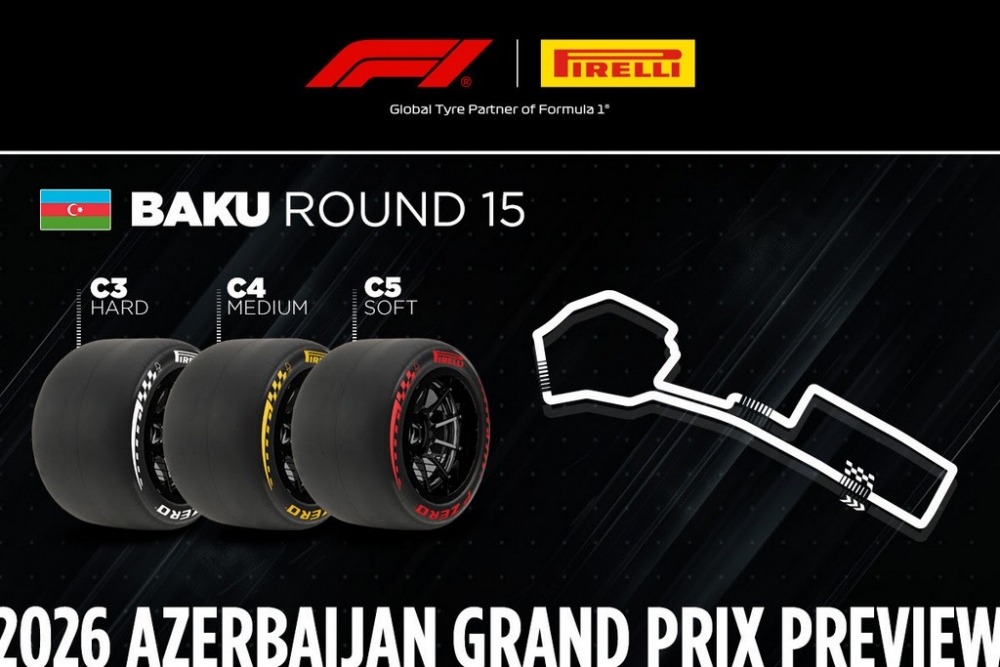
For this event, Pirelli has selected the softest range of compounds: C3 as Hard, C4 as Medium and C5 as Soft. Last year, the selection was one step softer and included the C6 as Soft. However, that compound was not used in the race, as drivers preferred to extend their stints and retain greater strategic flexibility by relying on the C5 and C4. This year, the race weekend schedule has been brought forward by one day, with the first two practice sessions taking place on Thursday, qualifying on Friday and the race on Saturday at 15:00 local time.
The asphalt, which is relatively smooth and not very abrasive, should result in very low levels of wear and degradation, making a one-stop race the most likely scenario. The C5 could prove capable of delivering particularly long stints, as seen recently at Monza, a circuit that shares some characteristics with Baku. By contrast, the Hard compound could be overlooked by many teams in the race.
Some graining may occur, particularly during the opening sessions when grip levels are still low, but it is not expected to be a decisive factor in terms of performance.
Despite being a street circuit, Baku places significant loads on the tyres due to the extremely long main straight and the many low-speed acceleration zones. It is a typical stop-and-go layout, where braking stability and the ability to maximise traction on corner exit are crucial. Aerodynamic efficiency is also particularly important and a car with low drag could enjoy a clear advantage.
One of the most interesting tyre-related aspects will be temperature management. The very long full-throttle section linking the final corner to the first promotes tyre cooling, aided by developments in wheel rim design. This phenomenon could increase the risk of lock-ups under heavy braking, particularly on the front axle.
Ambient temperatures could also help keep tyre overheating under control. Despite the generally warm climate, the buildings lining the circuit create numerous shaded areas, limiting any rise in track temperature.
IN 2025
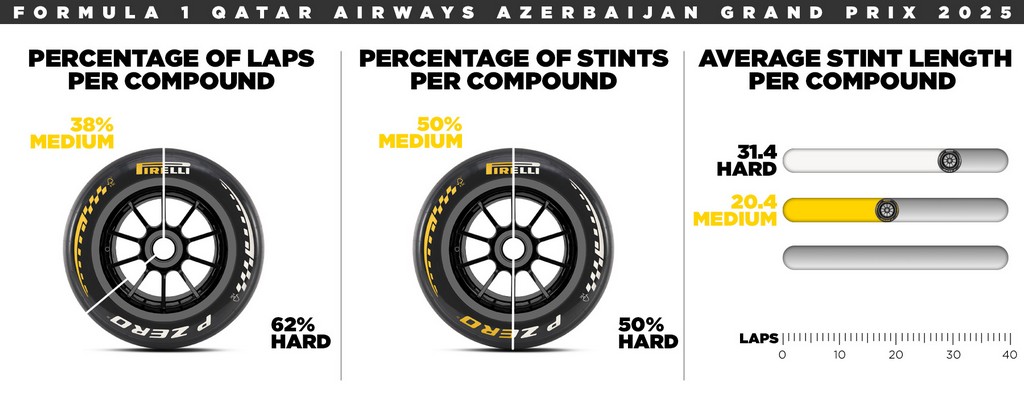
At the start of the Azerbaijan Grand Prix, 11 drivers opted for the C5 Medium and nine for the C4 Hard. All drivers completed a one-stop race and the C6 Soft was never used on Sunday. Esteban Ocon, after being forced to pit on the opening lap to replace a damaged front wing, fitted the Medium tyres and completed the entire race distance on that set.
STATISTICS
The upcoming Azerbaijan Grand Prix will be the tenth to be held on the streets of Baku. Eight editions have been run under the Azerbaijan Grand Prix title and one, in 2016, as the European Grand Prix. Sergio Perez and Max Verstappen are the only drivers to have won more than once in Baku, with two victories each. Red Bull is the most successful team at the venue, with five wins. Charles Leclerc holds the record for the most pole positions, having started from the front of the grid on four occasions.